PIPELINES AND DEMOCRACY:
Explaining EU Alignment Against Russia After the 2022 Invasion of Ukraine
by Tobin Albanese
Volume 1 Mon Jun 08 2026
This project analyzes why European Union member states aligned against Russia after the invasion of Ukraine, despite entering the crisis with uneven exposure to Russian oil and natural gas. Using sanctions behavior, UN voting alignment, energy reliance, democracy scores, and military spending, the paper argues that energy dependence shaped the costs and constraints of alignment, but democratic institutions emerged as the stronger predictor of formal opposition to Russia.
The European Union’s response to Russia’s invasion of Ukraine in 2022 has been presented as a unified defense of European security and democratic sovereignty. Beneath the appearance of institutional cohesion exist complicated patterns of political behavior among member states, especially sanctions policies intersecting with the dependence on Russian energy within these actors. This paper originally expected Russian energy dependence to constrain foreign policy autonomy, but the Stata results show a more complicated pattern. Where energy reliance mattered as a background constraint, while democracy was the stronger predictor of formal alignment against Russia. Although EU members faced the same geopolitical crisis and operated within the same institutional framework, they never entered the sanctions debate with similar economic exposure to one another. This makes energy dependence central to explaining why unity between EU member states is necessary but is still unevenly experienced.
Before the war, the EU-Russia energy relationship had developed into a deeply embedded form of economic interdependence shaped primarily around the already built pipeline infrastructure, long-term contracts, and the assumption that trade could stabilize political relations between member states and the Russian Federation.[1] Russian oil and natural gas were not just simple, ordinary market goods; these hydrocarbons are strategic resources connected to industrial production, household energy prices, and national security planning.[2] The invasion of Ukraine began to expose these contradictions that the EU thought would occur with rising risks of a full-scale invasion by Russia. Russia’s aggression created pressure for a collective European and Western response through sanctions, diplomatic condemnation, and complete support for Ukraine, yet the economic costs of those measures were not distributed evenly across the union itself. Some states could endorse stronger sanctions with fewer domestic consequences, while others had to weigh geopolitical alignment against energy supply, future inflation, industrial pressures, and public backlash. This does not mean that highly dependent states would automatically support Russia or reject sanctions either; rather, it suggests that their range of foreign policy flexibility was narrower than that of less dependent states.
This paper asks: to what extent do Russian fossil fuel reliance, democracy, and military spending explain EU member-state alignment against Russia after the 2022 invasion of Ukraine? At the beginning of this project, I expected energy dependence to be the strongest explanation because states more reliant on Russian fossil fuels would likely face greater domestic and economic costs from sanctions. However, the Stata results complicated that expectation. Fossil fuel reliance moved in the expected direction, but it was not strong enough to explain alignment by itself. Military spending also did not provide a strong explanation. Instead, the clearest finding was that more democratic EU member states were more likely to align against Russia through sanctions and United Nations voting behavior. Because of this, the paper argues that democratic institutions were the stronger predictor of formal alignment against Russia, while Russian energy reliance still mattered as a background constraint that shaped the overall costs, pressures, and limitations behind that alignment.
Literature Review
The literature on economic interdependence gives this paper its starting point because the EU-Russia relationship before 2022 was built primarily around trade, energy, and the assumption that economic connection could make conflicts like this less likely to occur. Liberal theories of international relations often argue that when states trade with one another, they become less willing to engage in any form of open confrontation because conflict would damage both sides economically and politically in the global international system. Keohane and Nye’s work on complex interdependence is useful here because it explains how states are connected through multiple channels, rather than only through military power or formal diplomacy. Before Russia invaded Ukraine, this logic helped describe Europe’s relationship with Russia well. Russia depended on European energy purchases, while many European states depended on Russian oil and natural gas. Where on paper, this kind of relation should have created restraint, but that didn’t happen.
The problem is that interdependence does not always mean equal dependence. That is where the literature becomes a useful tool for understanding the broader scope of this paper. Hirschman’s work on foreign trade and national power helps explain why economic relationships can produce leverage when one side has fewer alternatives than the other. This approach is important because EU member states were not going to be exposed to Russian energy sanctions in a uniform way, with some states heavily relying on pre-existing pipelines and contracts compared to others. Some countries with deeper energy ties to Russia due to their geographical region, pipeline infrastructure, long-term contracts, and domestic energy decisions made long before the war started, resulting in these unrelatable circumstances. Other EU states that held more diversified supplies and resources could adapt more easily during a time of sanctions and economic restraint. So even though the EU responded collectively, the costs of that response were never going to be distributed equally across all member-states. This unevenness in exposure is what makes energy dependence politically relevant as well.
Energy is different from ordinary trade because it is tied directly to state capacity and domestic stability. Oil and natural gas are connected to household prices, industrial output, transportation, and public confidence in government. A country can try to replace some commercial goods without major political damage, but energy disruption is a far harder resource to absorb. From a political and strategic standpoint as well. Scholars who write on EU energy security have made this point by showing how import dependency, price volatility, and uneven exposure across member states shaped Europe’s vulnerability before and after the war. Helping to explain why Russian fossil fuel reliance originally seemed like a strong explanation for differences in sanctions behavior. If sanctions sharply threatened the energy supply or raised prices, then more dependent states would have stronger incentives to move carefully. The literature on sanctions as well, also supports this form of expectations. Sanctions are often described as foreign policy tools, but they are never cost-free. They create pressure on targeted states while also producing costs for the states imposing on them. Research on Russian oil exports under sanctions shows that sanctions forced both Russia and Europe to adjust their economic behavior, with Russia searching for alternative buyers and Europe trying to reduce its exposure to Russian energy markets. Sanctions are not just another symbolic statement but are material policies with domestic consequences. For EU member states, supporting sanctions against Russia meant accepting some level of economic adjustment within their own borders.
The literature suggests that material exposure cannot explain everything within sanctions policies. States do not make foreign policy decisions based solely on energy prices or military capacity. Political institutions matter too. This is where democratic values become more of a central point to this research project than originally expected. Democratic states often face stronger public accountability, stronger legislative oversight, and greater pressure to align foreign policy with liberal norms like sovereignty, human rights, and opposition to aggressive actions. In the Russia-Ukraine case, democratic identity likely shaped how EU member states understood the war itself. Russia’s invasion was not only a security issue. It was also seen as an unprovoked and clear act of aggression under international law and further attacked democratic sovereignty and the rules that protect smaller states from annexation. Within this research, the Stata results emphasized that democracy had a clearer relationship with alignment than Russian fossil fuel reliance or military expenditure. Democracies are often more likely to cooperate with other democracies, support international institutions, and condemn violations of sovereignty through formal diplomatic channels. In the EU context, this does not mean every democratic state will still end up responding the same way. Domestic politics and economic pressure still matter in this. But stronger democratic institutions may make alignment against Russia more politically natural because the conflict was framed around defending Ukraine’s right to exist as an independent democratic state.
Recent scholarship on European political consensus after Russia’s invasion also helps support the main points of this argument. Analysis of EU institutional responses to the war shows that the invasion created strong pressure for collective alignment, especially around Ukraine, sanctions, and opposition to Russian aggression. This does not mean there were no disagreements inside Europe. There clearly were open discussions and back-and-forth political remarks regarding this war. But formal voting behavior can still capture the broader consensus more than the smaller forms of hesitation or bargaining that occurred behind closed doors. That distinction matters for this research because United Nations voting alignment may show where states stood publicly, while energy dependence may show the constraints they felt privately. Military spending was an original possibility for explaining the hypothesis, but the literature gives mixed reasons to expect it to matter more than it actually does. A country that spends more on defense may view Russia as a greater threat and align more strongly against it. That would make sense, especially for countries regionally closer to Russia or more concerned about security within the European region. A state may spend more on defense for reasons unrelated to Ukraine or Russia, while a lower-spending state may still strongly support sanctions because of democratic values or institutional commitments. This is why military spending as a variable was useful to include in the model, but it was not sufficient to explain alignment entirely by itself.
Taken together, the literature points to three possible explanations for EU alignment against Russia. The first is energy dependence; states more reliant on Russian fossil fuels should face higher costs from sanctions and may show weaker alignment. The second is democracy; more democratic states may be more willing to align against Russia because the war was framed as a defense of sovereignty and democratic order. The third is security capacity, measured through military spending, which may influence how seriously states view the Russian threat. Original expectations focused mostly on energy dependence, but the literature aspect leaves room for democracy to matter as well. That ended up being the stronger pattern in the Stata results. Where Energy dependence still helps explain vulnerability, but democracy appears to explain a more formal alignment clearer.
Theoretical Framework: Asymmetric Interdependence
The theoretical framework behind this paper begins with asymmetric interdependence, which means that economic ties do not directly affect every state equally. States can trade with one another, benefit from continued exchange, and still hold very different levels of vulnerability. This matters for the EU-Russia relationship because Russian fossil fuels were embedded unevenly across Europe before the 2022 invasion. Some EU member states were heavily exposed to Russian oil, gas, and fossil fuel imports, while others had more diversified supplies or a stronger ability to adjust to the conditions the conflict had created. So, even though the European Union responded through shared institutions, member states were not operating from the same material position. This is where interdependence becomes politically restrictive. A country can still oppose Russian annexation or aggression while still facing real economic pressure when sanctions begin threatening energy prices, industrial output, and public stability domestically.
Russian fossil fuel reliance was the original theoretical expectation at the beginning. But energy is connected to state capacity in a way that many traded goods are not. Oil and natural gas affect household costs, transportation, industrial production, and broader economic stability. If energy prices begin to spike, citizens are the first to feel it, and governments must answer for those disruptions. Based on that logic, EU member states that relied more heavily on Russian fossil fuels should have had stronger incentives to move carefully, bargain for flexibility, or show weaker alignment against Russia. This does not mean energy-dependent states are sympathetic to Russia either. That would be too simple; it means that alignment is not only about moral opposition to aggression, but also what a government can politically and economically sustain. This is where democracy shows a stronger competing explanation. More democratic states may be more likely to align against Russia because the war was framed around sovereignty, accountability, and opposition to authoritarian aggression. This doesn’t mean that democracies are automatically consistent or moral in every foreign policy decision. They are still states, and they still respond to interests, costs, and geopolitical pressures individually. But democratic institutions may shape how leaders interpret aggression and how easily they can justify alignment with other democracies. Military spending is also included as a possible explanation, but it may measure capacity more than political aspects will. Based on this theoretical framework, this paper aims to explain these three expectations: higher Russian fossil fuel reliance should be directly associated with weaker alignment against Russia, stronger democracy should correlate with stronger alignment, and military spending should have a less consistent relationship with formal UN voting and sanctions behavior.
Research Design: Measuring Energy Dependence and Political Alignment
Building on the preceding theoretical framework, this paper uses a cross-sectional research design to examine whether Russian fossil fuel reliance, democracy, and military spending help explain EU member-state alignment against Russia after the 2022 invasion of Ukraine. The European Union is a useful case for this project because its members operate within a shared institutional structure, but they still differ in their energy exposure, economic capacity, and security priorities within the European region. That combination helps to make comparisons more controlled than studying countries across the entire international system, while still leaving enough variation to test why some states could align more strongly against Russia than others. The unit of analysis is the individual EU member state, since the main question is not whether the EU opposed Russia as a collective actor, but why member states varied in their level of alignment, consistency, or flexibility during a time of evolving sanctions and foreign policy changes. The study focuses primarily on the post-2022 sanctions environment because Russia’s full-scale invasion of Ukraine turned energy dependence from a background issue into a more direct political circumstance.
Before the war, Russian fossil fuels were part of normal economic planning for many European countries. After the invasion, those same energy relationships became tied to sanctions, diplomatic pressure, inflation, and national security. Using a cross-sectional design allows this paper to compare member states during this shared crisis period and test whether pre-war fossil fuel reliance shaped later alignment against Russia. A larger project could help track more variables over a longer stretch of time, but the scope of this paper held a more focused goal: to test whether energy dependence, democracy, and military spending help explain post-2022 alignment, given the data that’s publicly available. The dependent variable is the actual political alignment against Russia. This is measured through formal indicators such as the United Nations voting alignment and sanctions-related behaviors. These measures are imperfect because they cannot capture every behind-the-scenes negotiation, exemption request, or domestic debate inside every EU country. Still, they help provide a structured way to compare how EU member states positioned themselves against Russia in public and institutional settings. UN voting is especially useful because it helps to create a visible record of diplomatic alignment, even though it may be too broad to capture a more subtle difference in sanctions bargaining or hesitation. This limitation is especially important because it does not make the measure entirely useless; it just means that the end results need to be interpreted in a more careful manner.
The main independent variable of this project is Russian fossil fuel reliance before the war. This variable is used to measure material exposure to Russian energy, especially oil, gas, and broader fossil fuel imports. The theoretical expectation is that countries more dependent on Russian energy would face greater costs from sanctioning Russian imports and might show weaker alignment against it as well. This follows the theoretical logic of asymmetric interdependence because dependence becomes politically meaningful when some states have fewer alternatives than others. Energy reliance is especially relevant because fossil fuels are tied directly to industrial output, transportation, and economic stability. A government may support sanctions against Russia in principle, but if those sanctions begin threatening domestic stability, the political calculation becomes far more difficult. Democracy is treated as a central competing explanation rather than just another control variable. The Stata output after regression analysis showed democracy to be the clearest predictor of UN alignment. More democratic states happen to be more likely to align against Russia because the war was framed around sovereignty, accountability, and opposition to authoritarian aggression. This helps to show how democratic institutions may shape how leaders understand Russia’s actual reasoning behind their aggression and how easily they can justify their alignment with Ukraine and other democratic states.
The model also includes GDP per capita because wealthier states may be better able to absorb the economic costs of sanctions, energy diversification, and price volatility. Economic capacity helps shape how much pressure a government can tolerate during a foreign policy crisis. When a wealthier state has more fiscal room to support its domestic households, subsidize energy costs, or adjust domestic supply chains. A less wealthy state may face stronger domestic pressure when regular goods pricing begins to rise and falls onto its average consumer markets. Including GDP per capita helps prevent the analysis from treating energy dependence as the only material factor shaping this alignment. The empirical strategy behind this uses ordinary least squares regression in Stata. The model estimates political alignment as a function of Russian fossil fuel reliance, democracy score, military spending, GDP per capita, and an error term. The goal is not to prove causality in an absolute way. With a cross-sectional design and a small number of EU cases, that would be too strong a claim by itself. Instead, the purpose is to analyze whether the relationships predicted by theory appear in the data and whether they remain visible once competing explanations are included in the same model. In practical terms, this means testing whether fossil fuel reliance still matters once democracy, military spending, and economic capacity are fundamentally considered.
A fixed-effects model is not used because this project does not rely on a panel dataset. Fixed effects are better suited for studies that try to observe the same country over multiple years. This paper compares EU member states after the invasion, using pre-war fossil fuel reliance to help examine post-2022 voting alignment. A future version of this research could expand the dataset across time and compare pooled OLS, country fixed effects, and year fixed effects. That would make it possible to test whether changes in energy dependence predict changes in sanctions behavior or UN voting alignment. For this version, the research design is intentionally narrower. Before testing the full regression model, it is necessary to first find out whether the basic patterns in fossil fuel reliance and alignment appear in the data
Empirical Analysis: Patterns of Dependence and Alignment
This paper examines whether Russian energy dependence operated as a constraint on foreign policy alignment. The first empirical task was not aiming to prove causation immediately, but instead to establish whether EU member states entered the post-2022 sanctions environment with meaningfully different levels of material exposure. If dependence on Russian fossil fuels were relatively equal across the EU, then asymmetric interdependence would have less of an explanatory force as a theoretical framework. However, if dependence was unevenly distributed, then it becomes more plausible that member states faced different levels of vulnerability when sanctions, diversification, and diplomatic alignment became urgent political questions. For this reason, the empirical analysis starts by examining whether the theoretical expectations developed in the previous sections appear descriptively in the data before moving into the more formal regression analysis that comes later.
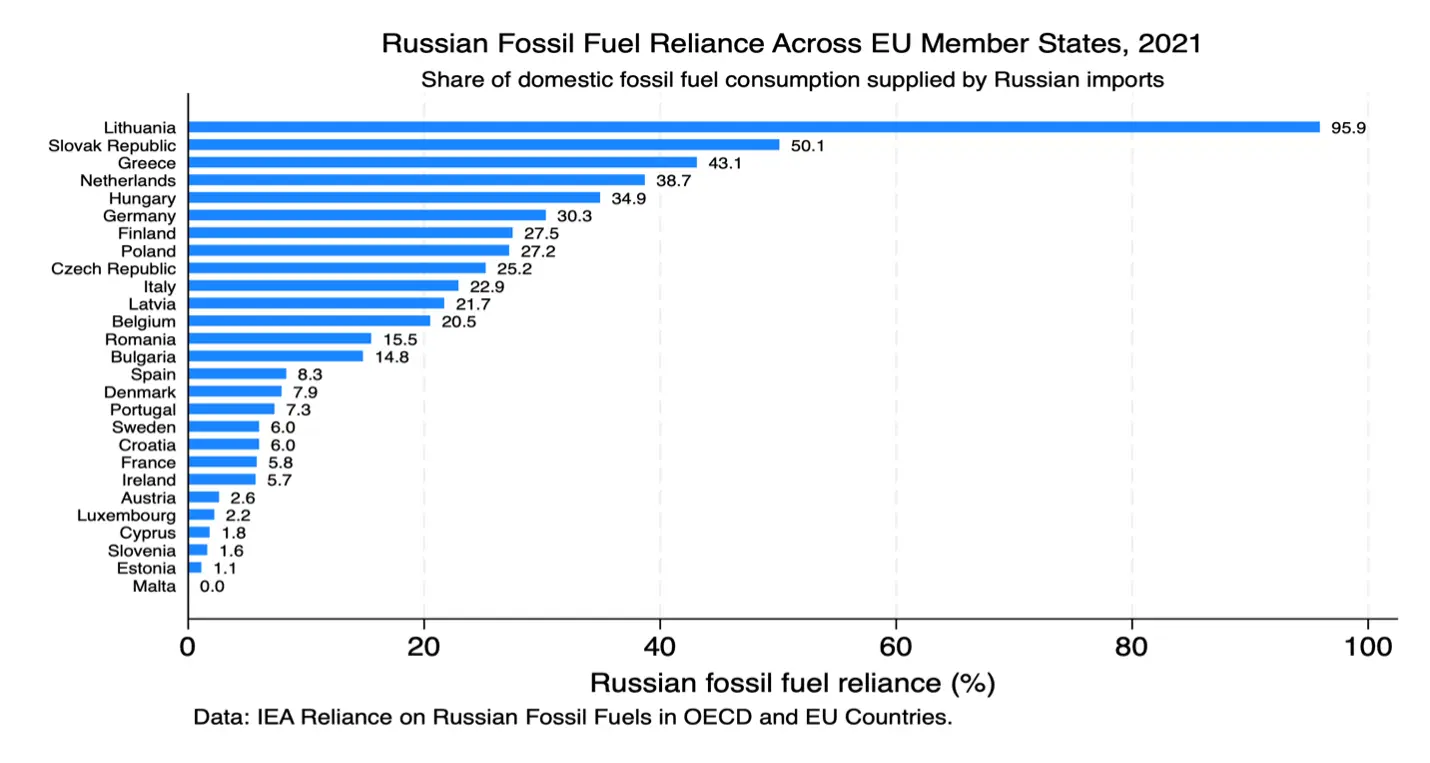
Figure 1 shows that Russian fossil fuel reliance was highly uneven across EU member states in 2021. Lithuania stands out as the highest-exposure case, while the Slovak Republic, Greece, the Netherlands, Hungary, Germany, Finland, Poland, the Czech Republic, and Italy also displayed relatively higher levels of reliance compared to the rest of the EU. At the lower end, Malta, Estonia, Slovenia, Cyprus, Luxembourg, Austria, Ireland, France, Croatia, and Sweden show limited reliance on Russian fuel imports. This shows that the EU’s collective response to Russia was built on unequal material foundations. Although member states operated within the same institutional framework and were responding to the same geopolitical crisis, they did not face the same energy costs or vulnerabilities when Russian fossil fuels became politically and strategically contested. Figure 1 provides descriptive support for the idea that European unity after 2022 should not be understood as the absence of internal constraint, but as a political response that took place across very different national exposure levels.
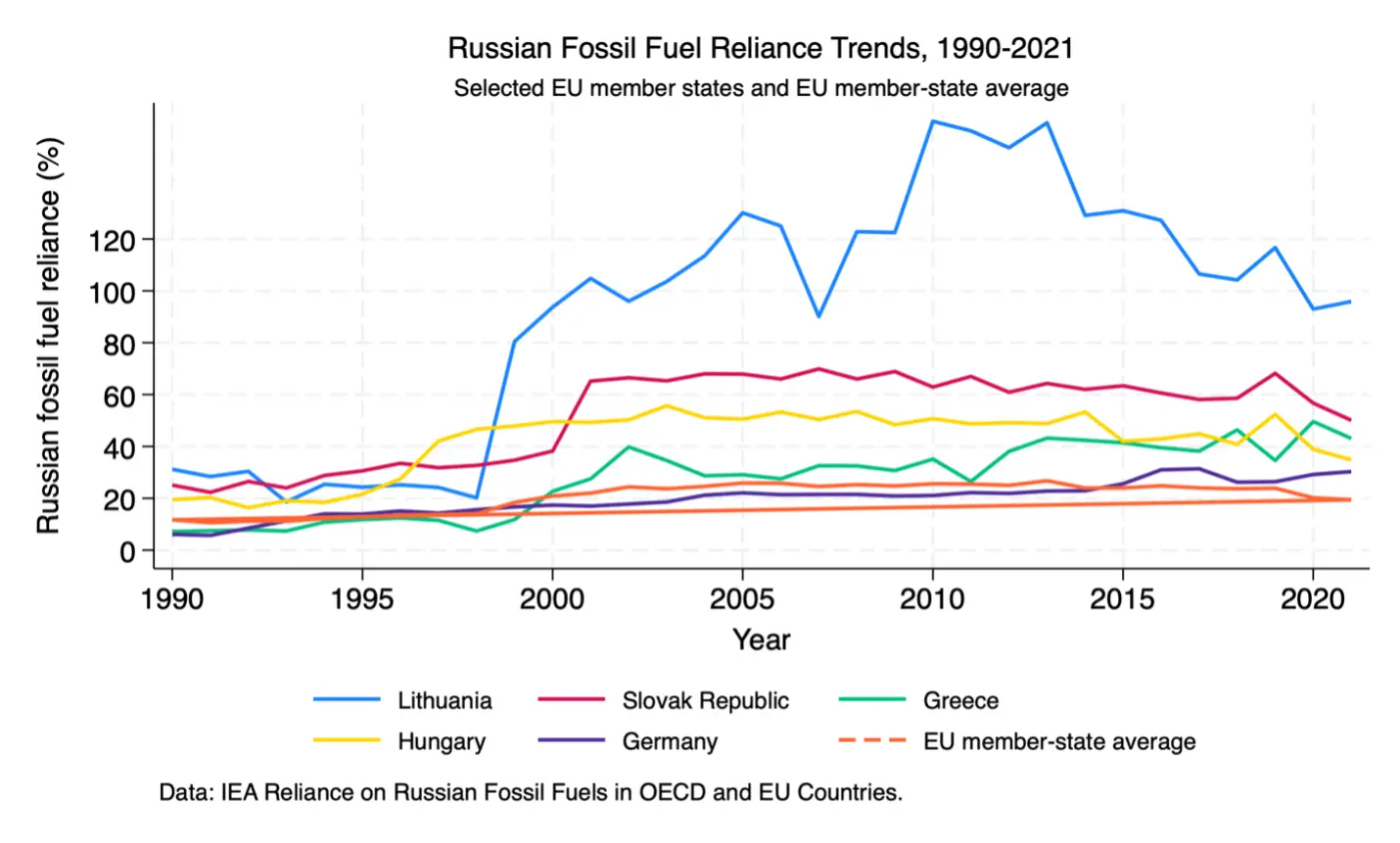
Figure 2 adds historical context by showing that Russian fossil fuel reliance was not an isolated condition in the years closely leading up to 2022, but part of longer patterns of energy dependence that developed across several decades. The dip around 2014 is also relevant because it occurred during the earlier Russia-Ukraine crisis, and before the full-scale invasion in 2022. The selected cases help illustrate how reliance varied across member states over time, with Lithuania and the Slovak Republic remaining as the higher-exposure cases, while Germany, Hungary, Greece, and the EU member-state average followed different values but still politically relevant trajectories. This matters for the theoretical argument because structural dependence is not produced overnight. It is shaped through infrastructure, contracts, geography, pipeline access, domestic energy policy, and the gradual normalization of Russian energy as part of national economic planning. By placing the 2021 snapshot in historical context, the figure helps situate energy dependence as a pre-war vulnerability rather than a post-war outcome. This distinction is important for the research design because the independent variable is intended to measure exposure before the major sanctions and diversification responses began to reshape European energy politics. Lithuania’s values above 100 percent should be interpreted as a feature of the IEA reliance dataset rather than a literal claim that domestic consumption exceeded total demand. Because the measure compares Russian imports to domestic fossil fuel consumption, values above 100 percent can occur when import volumes, storage, refining, or re-export dynamics start to exceed measured domestic consumption each year.
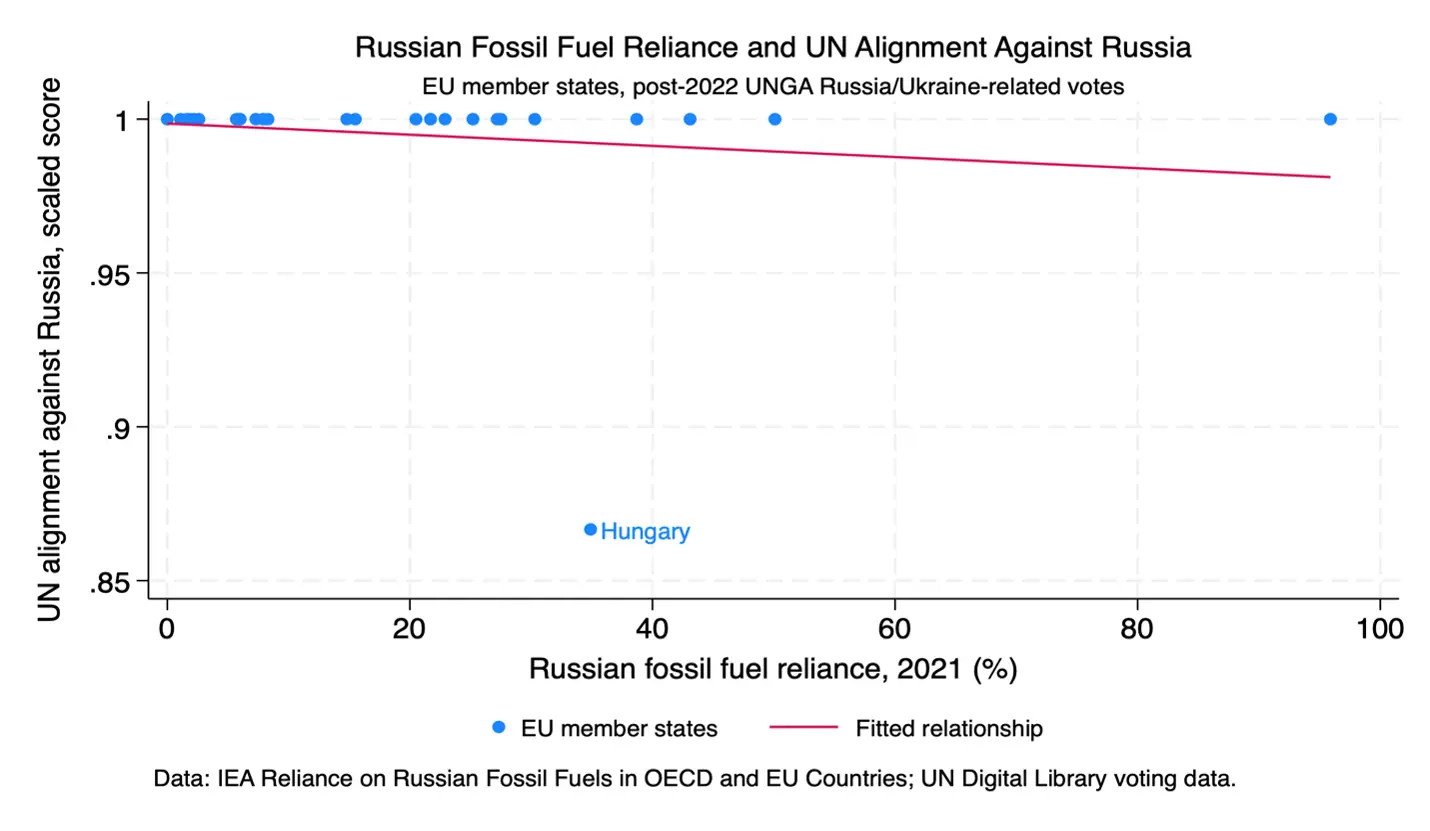
Figure 3 shows an initial visual comparison between pre-war Russian fossil fuel reliance and post-2022 UN alignment. The fitted relationship moves in the expected negative direction, suggesting that higher reliance is associated with slightly weaker formal alignment against Russia. Hungary is the clearest case in this pattern, combining relatively high fossil fuel reliance with lower UN alignment compared to the rest of the EU. This figure also reveals an important limitation in the dependent variable: most EU member states tend to cluster together near full alignment, which means UN voting captures diplomatic unity more clearly than the subtler forms of hesitation, bargaining, or sanctions resistance that may occur within political decision-making. This does not make the measure entirely useless, but it does mean that the findings should be interpreted more carefully. The figure suggests that the relationship moves in the direction anticipated by the hypothesis; it also shows that formal UN voting may be too blunt to fully capture the political constraints created by asymmetric energy dependence.
Taken together, these descriptive patterns support the original logic of the paper while also clarifying the limitations of the evidence. The first two figures establish that Russian fossil fuel dependence was uneven and historically embedded across EU member states before the full-scale invasion of Ukraine, while the third figure provides an initial indication that greater dependence may correspond with weaker formal alignment against Russia. However, because visual patterns alone cannot determine whether this relationship persists when other factors are considered, the next section turns to regression analysis. That analysis tests whether the negative relationship between Russian energy dependence and political alignment remains visible after accounting for economic capacity, democratic institutions, and security-related control variables.
Regression Analysis: Relationship Between Dependence and Alignment
The regression analysis builds on the descriptive patterns shown in the previous section by testing whether the relationship between Russian fossil fuel reliance, democracy, military spending, and GDP per capita helps explain EU member-state alignment against Russia. Section V showed that EU member states entered the post-2022 sanctions environment with highly uneven levels of energy exposure, and it also suggested that the relationship between dependence and UN alignment moved in the expected negative direction. However, the figures alone cannot determine whether this pattern is meaningful once competing explanations are introduced. For that reason, this section uses ordinary least squares regression as a baseline empirical strategy to evaluate whether higher Russian fossil fuel reliance is directly correlated with weaker post-2022 alignment against Russia, while also accounting for economic capacity, democratic institutions, and military spending.
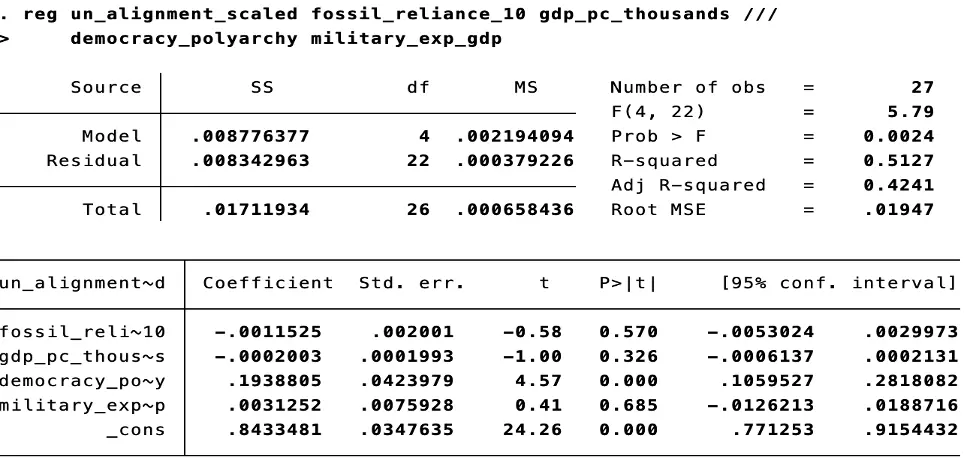
Table 1 shows the full regression model predicting post-2022 UN alignment against Russia. The coefficients for Russian fossil fuel reliance are negative, which is consistent with the direction expected by this paper’s hypothesis. Substantively, the estimate suggests that a ten-percentage-point increase in Russian fossil fuel reliance is associated with a very small decrease in predicted UN alignment against Russia, holding GDP per capita, democracy, and military spending constant. However, the size of this coefficient is limited, and the relationship is not statistically significant either. This means the regression does not provide strong enough evidence to claim that energy dependence alone explains formal UN voting alignment among EU member states. However, the control variables complicate the relationship in important ways. GDP per capita is negative in the full model, while military spending is close to zero, suggesting that neither economic capacity nor military expenditure provides a clearer independent explanation in this project. By contrast, the electoral democracy index has a positive and statistically meaningful relationship with UN alignment. This indicates that more democratic member states tend to show stronger formal alignment against Russia in UN voting. For this project, that finding is important because it does not simply disprove the energy-dependence argument but instead suggests that energy exposure itself operates within a broader political environment shaped by democratic institutions, foreign policy identity, and normal commitment behavior towards opposition against territorial aggression.
From these variables and regression results, the paper shifts away from the original approach that Russian fossil fuel reliance would be the clearest predictor of alignment. Fossil fuel reliance still moves in the negative direction as expected, but its p-value of 0.570 means the relationship is not statistically significant in this model. Military spending also fails to explain alignment clearly, with a p-value of 0.685. The strongest finding from running the regression was how influential the Democracy variable was. The democracy variable is positive and statistically meaningful, suggesting that the more democratic EU member states were, the more likely they were to align against Russia through UN voting. From this perspective, this does not mean energy dependence is entirely irrelevant; it just means that energy dependence may explain pressure and constraint, while democracy better explains formal alignment.
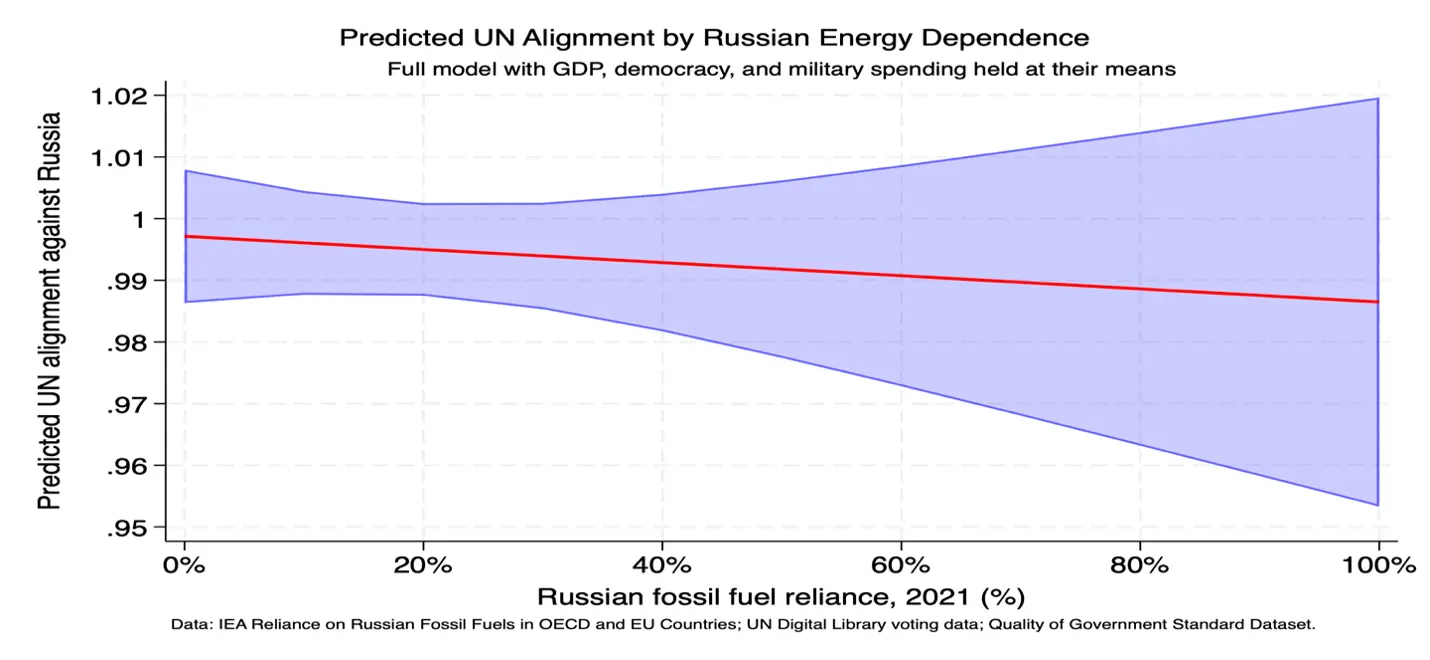
Figure 4 visualizes the predicted relationship from the full regression model while holding GDP per capita, democracy, and military spending at their sample means. The red prediction line slopes slightly downward, which again matches the theoretical expectation that higher Russian energy dependence should correspond with weaker alignment against Russia. The confidence interval widens substantially at higher levels of dependence. The widening interval shows that the model becomes less certain when estimating alignment for highly dependent states, partly because there are relatively few EU member states to begin with and only a small number of extremely high-dependence cases. The figure, therefore, makes the regression results easier to interpret when the direction of the relationship supports the hypothesis, but the evidence is not strong enough to directly claim that energy dependence is a decisive predictor of UN voting behavior by itself.
After discovering the findings, the regression analysis offers a more conservative support for the paper’s argument. Russian fossil fuel reliance moves in the expected negative direction, but the relationship itself is weak when measured through only UN voting alignment data. The stronger result for democracy suggests that formal diplomatic alignment against Russia may be shaped by political-institutional factors rather than by energy dependence alone. At the same time, this limitation is also substantively meaningful. Because most EU member states were nearly unified in UN votes after 2022, UN alignment may be too direct of a dependent variable to capture the quieter forms of constraint that this paper is mainly aiming for. Such as sanctions bargaining, hesitation over energy embargoes, or pressure for exemptions. The overall regression, therefore, does not overturn the theory of asymmetric interdependence, but it narrows the claim: energy dependence appears less powerful as a predictor of formal UN voting than as a framework for explaining the political costs, exceptions, hesitation, and strategic variation that shaped how different EU member states responded to Russia in a practical sense.
Discussion: Democracy, Constraint, and Formal Alignment
The Stata results do not show that Russian fossil fuel reliance was irrelevant, but they do force the argument to become more careful. My original expectation was that states with higher dependence on Russian energy would show weaker alignment against Russia because sanctions policies tend to create greater domestic and economic costs both domestically and externally. The descriptive figures supported part of that perspective. Energy exposure was clearly uneven across the EU, and the visual relationship between fossil fuel reliance and UN alignment moved in the expected negative direction. But once the regression included democracy, GDP per capita, and military spending, energy dependence was no longer the clearest explanation. The strongest result was the democracy variable.
That shift was important in understanding how the findings should be correctly interpreted. More democratic EU member states were more likely to align against Russia through UN voting behavior, which suggests that formal diplomatic alignment was shaped more clearly by political institutions than by energy exposure alone. From my perspective, this makes sense because Russia’s invasion was not treated solely as a territorial dispute or a normal security crisis. It was framed as an attack on sovereignty, democratic self-rule, and the expectation that borders cannot simply be changed by force. The more democratic a state actor was, the higher the chance they had of stronger institutional and political reasons to align against Russia because the conflict challenged principles that democratic governments often claim to defend publicly. However, this does not mean democracies are going to always be consistent in foreign policy. They are still states, and they still respond to interest, cost, and political pressure. But in this case, democracy appears to explain formal alignment better than fossil fuel reliance or military spending alone.
This also helps explain why the energy variable did not perform as strongly as I was originally expecting. Energy dependence can shape pressure, but democracy appears to really shape the overall formal alignment. They are entirely different things. A government can vote against Russia in the United Nations and still face serious domestic concerns about energy costs, industrial disruption, or public frustration. That is why the original energy-dependence argument should not be disregarded or thrown out of the equation completely. It just needs to be more narrowly specified. Russian fossil fuel reliance seems better at explaining the constraints behind policy choices than explaining actual UN voting behavior directly. Therefore, energy dependence may show up less through open diplomatic opposition and more through political bargaining, hesitation, exemption requests, or slower movement on energy sanctions.
Hungary helps show this tension, but it should not be treated as proof by itself; it’s just not sufficient evidence either. Hungary stood out because it combined relatively high Russian fossil fuel reliance with weaker alignment compared to most other EU member states. But the broader issue is that formal alignment can hide practical differences. Most EU states remained aligned in UN voting, but that does not mean they experienced a relatively shared economic outcome from sanctions. Some governments could support faster disconnection from Russian energy with fewer domestic consequences, while others had to consider their own domestic infrastructure, supply routes, long-term contracts, industrial dependence, and energy costs. That is where the energy-dependence theory still matters, by helping to explain the cost side of alignment, even when it does not fully predict the public belief and vote.
The regression also shows why military spending was not enough to explain alignment. A state may spend more on defense because of geography, NATO expectations, domestic politics, or long-term security planning. But defense spending does not automatically translate into stronger diplomatic alignment either. In the model, military expenditure was actually closer to zero, which suggests that security capacity by itself did not explain how states positioned themselves in UN voting. GDP per capita also did not provide a good enough explanation, either. At first, I thought this would play a major role in alignment, but it wasn’t sufficient. In a panel dataset, though, I believe these variables could be stronger, and maybe it was a poor framework decision on my part to go with a cross-sectional dataset rather than a panel dataset. This is what made the democracy result stand out more against the other variables. Because, among the variables I had tested, democratic institutions held the strongest relationship with alignment against Russia, which wasn’t my initial assumption.
There are still many limitations to what this specific project and paper could claim. The research design is cross-sectional, meaning I tried comparing EU member states at one point in the post-2022 sanctions environment rather than tracking the EU and Russia across multiple years. Which, cross-sectional isn’t wrong necessarily, but in the sense of such a broad topic, the use of longer timelines, and more variables would’ve had a bigger effect on the variables I originally used. A panel design could have shown whether changes in energy dependence over time could help predict changes in sanctions behavior, UN voting, or diplomatic alignment. This project cannot fully answer that in the way I created it. It can only show which relationships appear in the available data at this stage. The dependent variable also creates another limitation within itself. UN voting alignment is useful because it gives a visible and comparable measure of formal diplomatic behavior, but it is too broad to capture everything happening beneath the surface. It does not fully measure sanctions’ bargaining, domestic energy politics, delays, exemptions, or the fundamental pressure governments faced from voters and industries.
The main takeaway from this cross-sectional research paper is that EU alignment after 2022 should be better understood through two layers. The first layer is formal alignment, where democracy appears to matter the most. The second layer is political constraint, where energy dependence still matters but is harder to see through UN voting alone. This distinction helps explain why the Stata results moved the paper in a different direction than I had originally expected. I started with the view that Russian fossil fuel reliance would be the strongest predictor, but the variables pushed my argument toward democracy instead. That is what makes the research paper stronger, not weaker, by seeing which variables happened to be insufficient and which became the strongest regardless of my original talking points. It shows that the data refined the original argument rather than confirming it. How energy dependence shapes vulnerability and pressure, but democracy better explained formal alignment against Russia. In class, we mentioned how when we are researching a project, if all our perspectives are correct, it ultimately leads to bias, and if I had just run with my original point, then I would be pushing biased information that wouldn’t have been supported by the actual Stata output as well. So, I am glad that my original take was incorrect, and that I could learn from how sanctions alignment works within democratic institutions and a conflict within a specific region.
Conclusion
The European Union’s response to Russia’s invasion of Ukraine looked unified from the outside, but this paper has argued that this unity was more complicated once member-state differences are taken seriously. EU countries responded to the same war and operated inside the same institutional framework, but they did not enter the sanctions environment from the same political or economic positioning. Some were more exposed to Russian fossil fuels, while others had stronger democratic institutions, different levels of importance in their military spending, and greater economic flexibility when facing an environment of sanctions. Because of this, EU alignment against Russia cannot be fully explained by one factor alone. It reflects both material constraints and political institutions.
Where the original expectation of this project was that Russian fossil fuel reliance would be the clearest explanation for weaker alignment against Russia. The theory behind these expectations was reasonable. Energy happens to be directly tied to industrial production, household prices, transportation, and public stability, so countries more dependent on Russian oil and gas should have had stronger incentives to move carefully when sanctions became more economically expensive. The descriptive Stata figures supported part of that expectation by showing that Russian fossil fuel reliance was uneven across EU member states and that the visual relationship between dependence and UN alignment moved in the expected negative direction. Therefore, helping to show that energy dependence was worth testing and that European unity was built on unequal material foundations.
From Stata, the regression results, however, narrowed down to the original claim. Russian fossil fuel reliance remained negative, but it was not strong enough to explain formal alignment by itself. Military spending also did not provide a sufficiently clear explanation. The strongest finding was the democracy variable. The more democratic EU member states were, the more likely they were to align against Russia through United Nations voting, suggesting that formal diplomatic alignment was shaped more clearly by political institutions than by energy exposure by itself. This does not make the energy dependence argument necessarily wrong. It just makes it more precise. Energy dependence helps explain pressure, constraint, and the costs behind alignment, while democracy better explains the public and formal alignment captured in the actual data. This distinction is the main takeaway from the paper. Russian fossil fuel reliance never determined whether a state fundamentally opposed Russia, but it was likely shaped by how costly that opposition would become. UN voting captures formal alignment, but it cannot fully capture the quieter forms of political constraint that occur beneath public diplomacy. Energy dependence mattered more as a background condition, while democracy stood out as the stronger predictor of formal alignment against sanctions and foreign policy within the region.
This project helped show why research methods matter in political science and undergraduate studies. The strongest argument is not always going to be the one that begins the project, but the one that grows into the strongest after the evidence is tested and analyzed. In this case, EU alignment against Russia after 2022 was shaped by both individual material constraints and democratic identity, but democracy explained formal alignment more clearly than energy dependence or military spending alone. European unity against Russia was real, but the forces beneath that unity were never evenly distributed. Therefore, the EU’s response to Russia should be understood not just as unification or division, but as a case where democratic commitment held formal alignment together while unequal energy dependence helped shape the pressures beneath the surface.
Resources & Archival References
Bibliography
- ResearchGate link for pdf download
- Russian Oil Exports under International Sanctions
- The European Parliament’s Foreign Policy Behavior: The Case of EU Foreign Policy towards Ukraine Following the Russian War of Aggression
- Dynamic Effects of EU Economic Sanctions on the EU-Russian Energy Market: Evidence on Crude Oil and Natural Gas
- From Vulnerability to Strategic Autonomy: Discursive Transformations in EU Energy Security (2003–2024)
- Geopolitical Crises and Consensus in the European Parliament: Initial Response to the War in Ukraine
- Russia and Europe’s Mutual Energy Dependence
- The Weaponization of Interdependence: Energy Security and the Geopolitics of the Green Transition
- Geopolitical Fractures in Energy Markets: Cross-Dimensional Analysis of Security, Socioeconomic, and Policy Landscapes under Russia-Ukraine Conflict
- The European Union’s Energy Security Challenges: Import Dependency, Volatility, and Differences Across Member States